VirtualBox
A free type-2 hypervisor for desktop virtualisation.
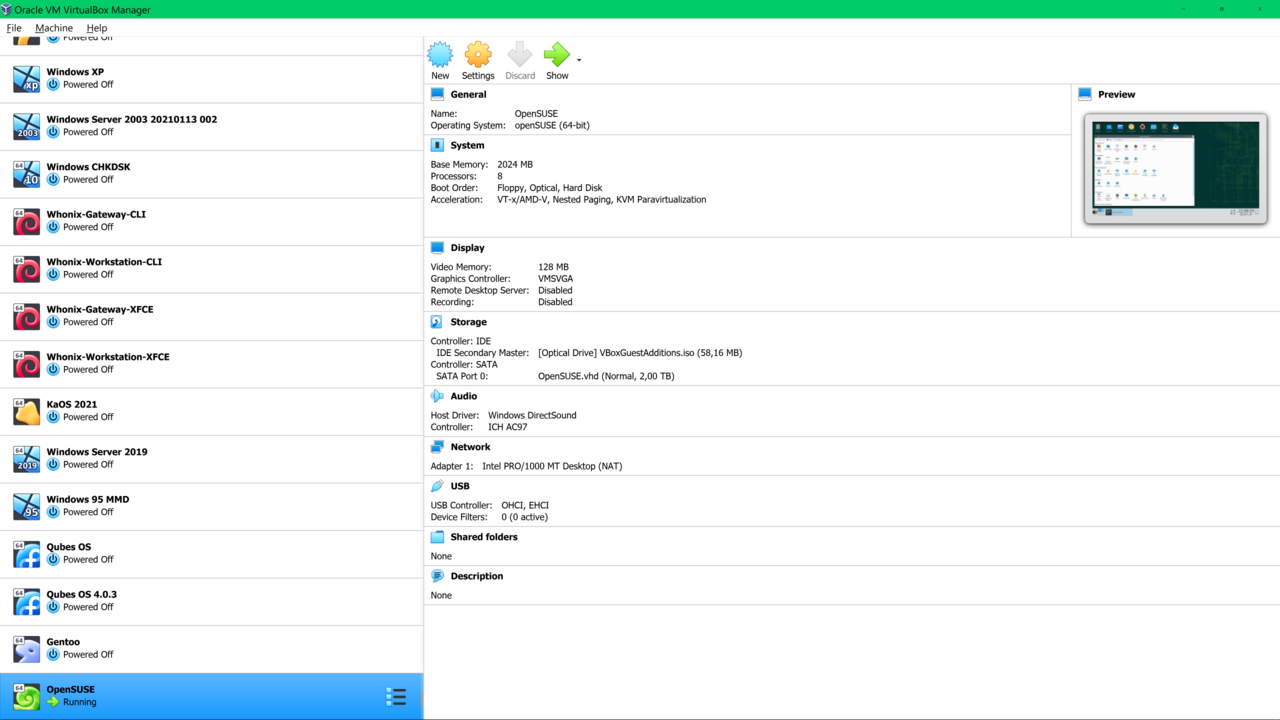
VirtualBox runs guest operating systems in virtual machines on top of a Windows, macOS, Linux, or Solaris host. It supports a wide range of guest OSes — Linux distributions, FreeBSD, OpenBSD, Windows back to XP, Solaris, OS/2, and even some classic operating systems — and exposes features like snapshots, shared folders, virtual networking with NAT and host-only modes, USB device passthrough, and a remote display protocol.
VirtualBox is developed by Oracle but the core hypervisor is released under GPL-3.0. The Extension Pack, which adds USB 2.0 and 3.0 device emulation, RDP server, disk encryption, and PXE boot for Intel cards, is under a more restrictive Personal Use and Evaluation Licence and is a separate download. For most non-commercial uses this is the practical default; commercial users need a VirtualBox commercial subscription for the Extension Pack.
Innotek originally developed VirtualBox before Sun Microsystems acquired it in 2008, and Sun's acquisition by Oracle in 2010 brought it under Oracle's stewardship. VirtualBox remains widely used for desktop virtualisation on Windows and macOS hosts, where it competes with VMware Workstation, Parallels, and Hyper-V. On Linux, KVM and libvirt have largely replaced VirtualBox for serious virtualisation work.
Install
Debian/Ubuntu: sudo apt install virtualbox
Fedora/RHEL:   sudo dnf install VirtualBox
Arch:          sudo pacman -S virtualbox
macOS:         brew install --cask virtualbox
Authors
- Innotek (original developer)
- Oracle Corporation
