GNOME
A free desktop environment focused on simplicity.
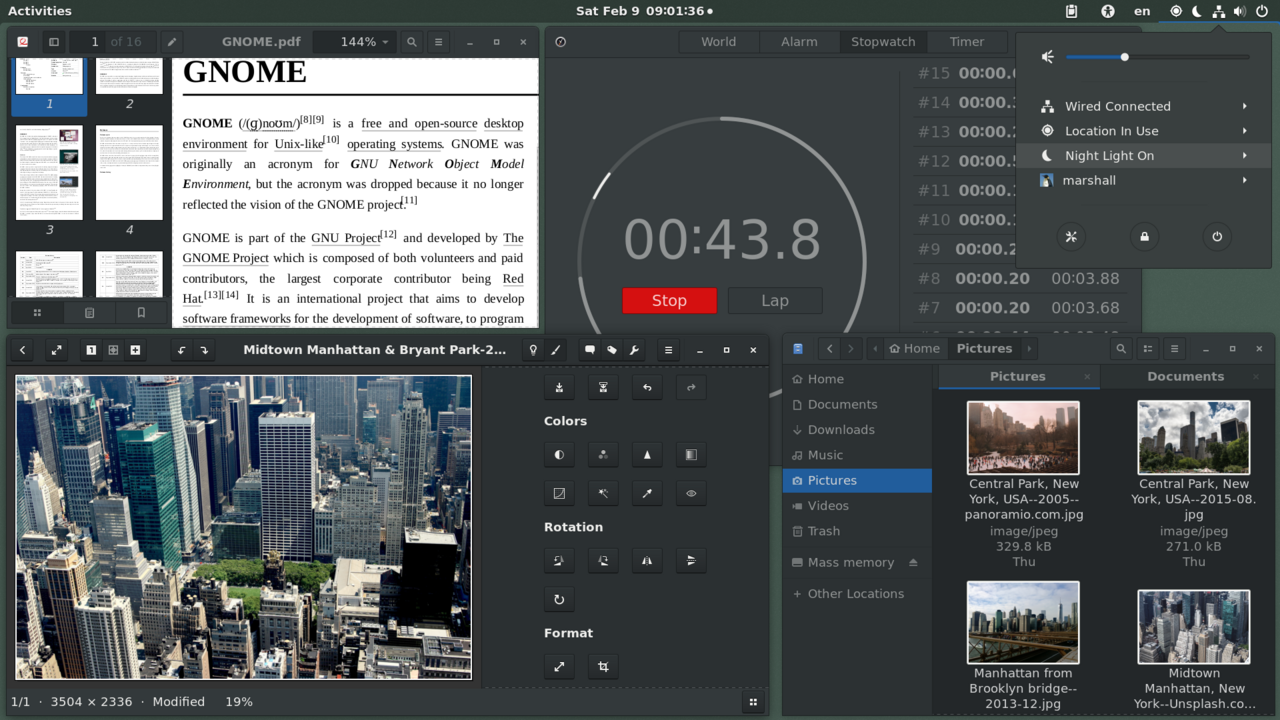
GNOME provides a complete desktop environment built around the Mutter window manager and GNOME Shell, plus a suite of applications (Files, Terminal, Calendar, Photos, Maps, Weather, Music, and others). The project emphasises a polished default experience with relatively few user-facing options — the design philosophy is "sane defaults that work for most people" rather than KDE Plasma's "configure everything" approach.
GNOME is the default desktop on Fedora Workstation, Ubuntu (since 17.10), Debian (with GNOME variant), Manjaro GNOME, and several other distributions. The GNOME Foundation governs the project and maintains the technologies (GTK, GLib, GStreamer, Cairo, Pango, GIO) that GNOME shares with the broader Linux ecosystem. Many of these underlying technologies are used by non-GNOME applications.
Major GNOME releases come every six months. GNOME 40 (2021) introduced the modern horizontal-workspace overview layout that remains the current design. Recent releases have continued to refine the GTK 4 / libadwaita visual language. GNOME's design direction has been controversial at times (the original GNOME 3 launch in 2011 prompted forks and substantial community disagreement), but the desktop has matured into a stable, distinctive Linux desktop experience.
Install
Already preinstalled on Fedora Workstation, Ubuntu, and others.
To install on a minimal system:
  Debian/Ubuntu: sudo apt install gnome
  Fedora:        sudo dnf install @gnome-desktop
  Arch:          sudo pacman -S gnome
Authors
- GNOME Foundation and contributors
